What THUB Technologies Builds: Engineering the Future of Smart Urban Infrastructure
Engineering the Cities of Tomorrow, Today
Urban environments are evolving at a pace that demands more than incremental improvement — they require a fundamental rethinking of how infrastructure is designed, managed, and sustained. At THUB Technologies, this challenge sits at the core of our R&D mission. As an engineering and technology company focused on advanced systems development, we work at the intersection of smart city infrastructure, intelligent automation, and sustainable built environments.
This article outlines the key areas in which THUB Technologies directs its research and engineering efforts, and why these disciplines are increasingly central to the future of urban life and institutional operations.
A Research-Driven Approach to Urban Systems
Why R&D Matters in Infrastructure Development
Infrastructure has traditionally been slow to change. Long asset lifecycles, complex procurement processes, and regulatory frameworks often create inertia. Yet the convergence of sensor technology, AI, robotics, and connectivity is opening up new possibilities — and new responsibilities — for companies willing to invest in long-term engineering development.
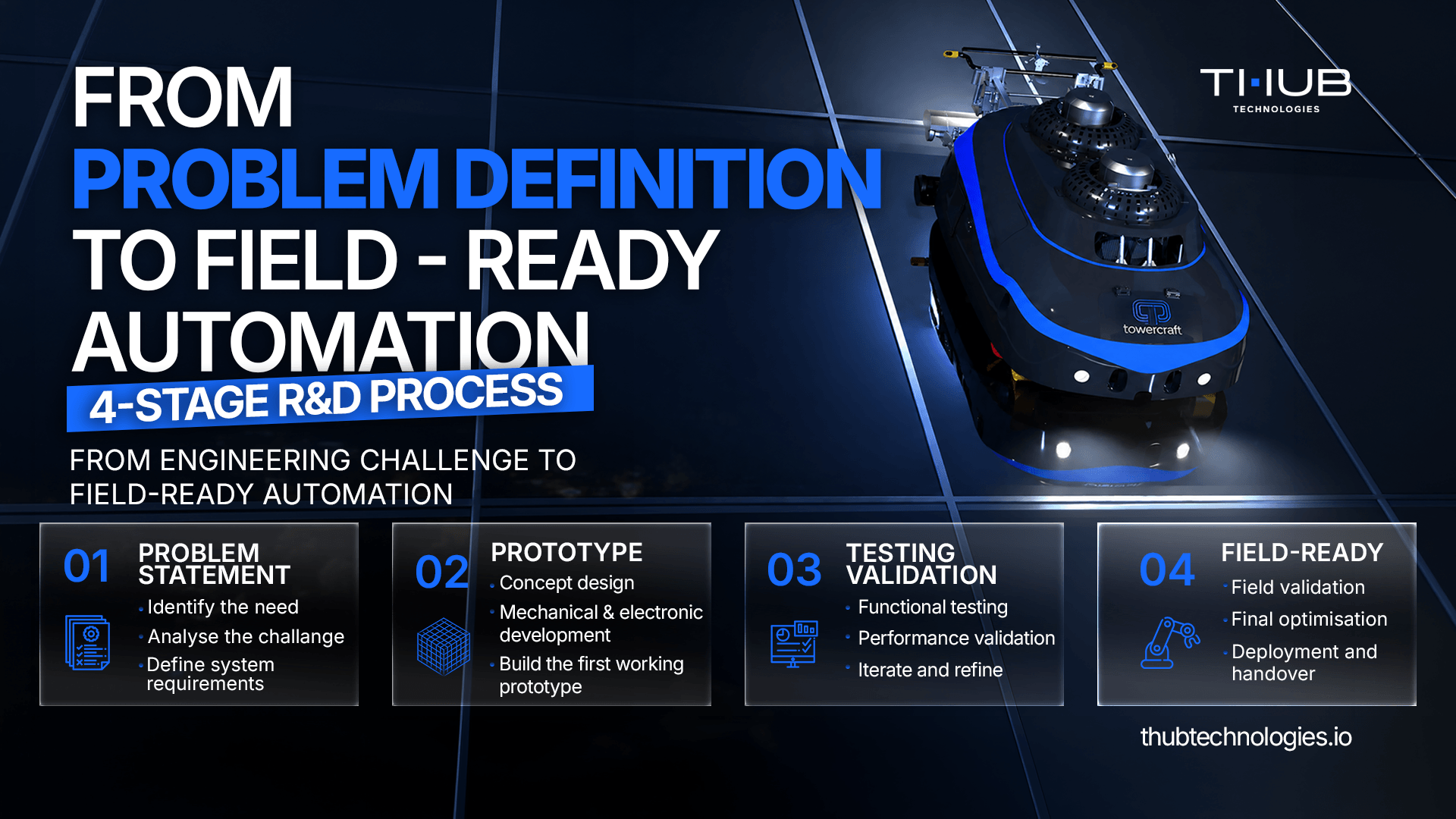
THUB Technologies operates as an R&D and engineering organisation, which means our work begins not with a product catalogue but with a problem definition. We examine where existing urban systems are inefficient, fragile, or unsustainable, and we apply engineering rigour to develop solutions that can operate at scale.
From Individual Buildings to City-Scale Intelligence
One of the defining shifts in smart infrastructure thinking is the move from building-level management to city-scale integration. Historically, a facility management team might monitor a single structure. Today, the aspiration is for interconnected systems — where energy usage, safety, maintenance cycles, and environmental data are managed holistically across entire urban districts.
THUB Technologies approaches this challenge by developing technologies that are modular, interoperable, and designed to integrate with existing urban platforms. Whether addressing a single high-rise or a broader development zone, the underlying architecture aims for coherence across systems.
Core Technology Domains
Intelligent Building and Facility Management
Sustainable building management is one of the most pressing challenges facing facility managers, property owners, and urban planners alike. Buildings account for a significant share of energy consumption in most cities, and the gap between current performance and potential efficiency is substantial.
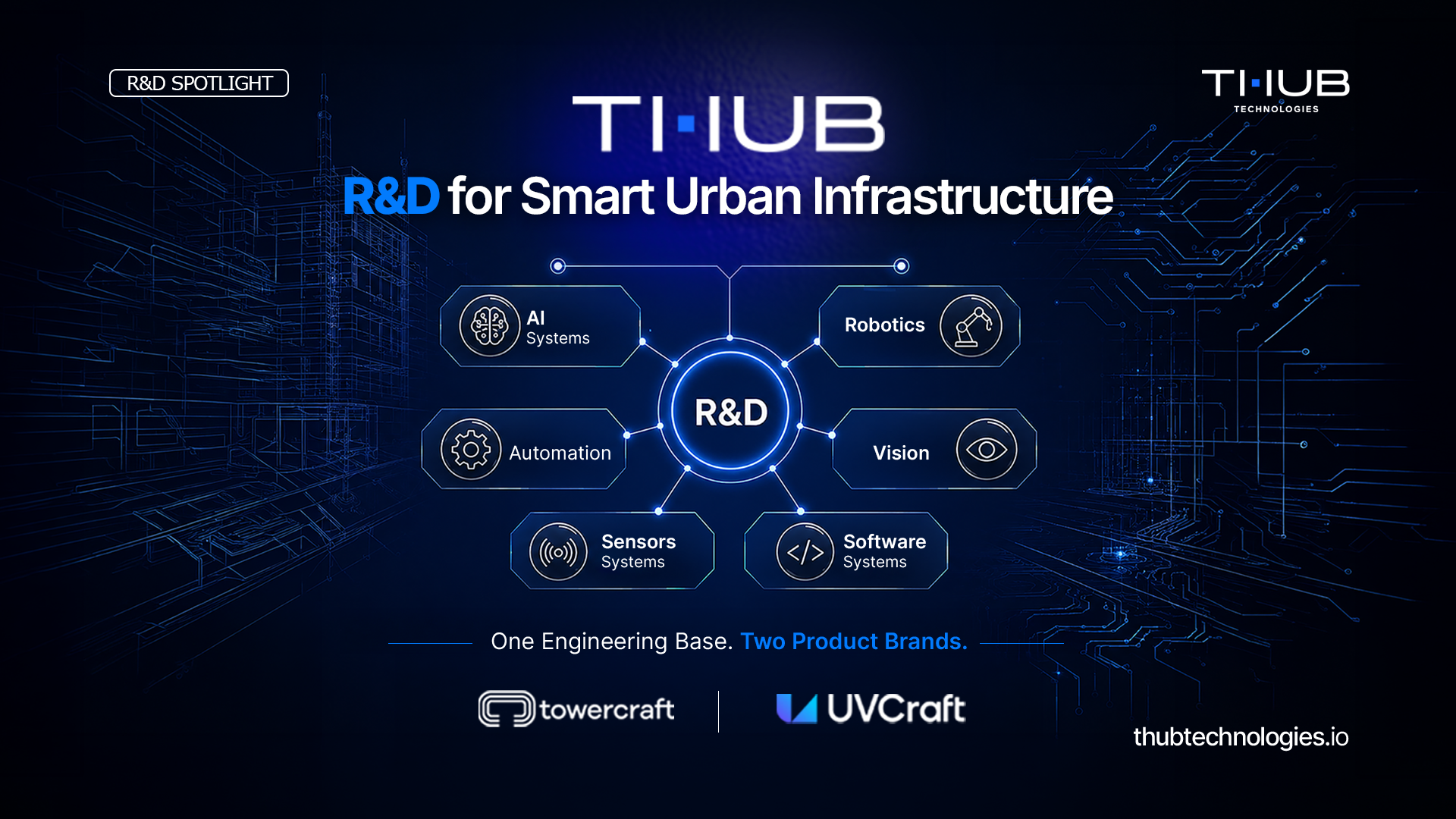
THUB Technologies develops systems that support data-driven decision-making in building operations — from monitoring environmental conditions to enabling predictive maintenance. The aim is not simply to automate existing processes, but to surface the right information at the right time so that human operators can make better decisions.
Robotics and Automation in Urban Contexts
Robotics and automation are no longer confined to factory floors. As the density and complexity of urban infrastructure increases, there is growing demand for robotic systems capable of operating in dynamic, real-world environments — performing inspection, maintenance, logistics, and safety functions that were previously labour-intensive or hazardous.
THUB Technologies invests in the development of robotic systems designed for deployment in these demanding environments. The engineering challenges are considerable: robots must navigate unpredictable terrain, operate safely alongside people, and deliver reliable performance under variable conditions.
AI-Supported Decision Architecture
Artificial intelligence is most valuable in infrastructure when it enhances human judgement rather than replacing it. THUB Technologies focuses on AI applications that process large volumes of operational data — from sensor networks, environmental monitors, and facility systems — and translate that data into meaningful, actionable insights.
This approach supports operators in identifying anomalies early, optimising resource allocation, and planning maintenance interventions before failures occur. In complex urban environments, the ability to act on data with speed and precision is a genuine operational advantage.
Sustainability as a Design Principle
Across all of THUB Technologies' engineering disciplines, sustainability is embedded as a foundational design criterion — not a feature added after the fact. Urban infrastructure that cannot adapt to tightening environmental standards, rising energy costs, and evolving regulatory requirements will face increasing operational and reputational risk.
By designing systems with long-term sustainability in mind, THUB Technologies helps clients and partners future-proof their assets and reduce exposure to these risks. This means engineering for energy efficiency, reduced material waste, and systems that remain relevant across extended lifecycle periods.
Looking Ahead: The Integrated Smart City
The vision shared by urban planners, technology developers, and city administrators alike is one of deep integration — where transport, energy, safety, communications, and building systems operate as a coherent, responsive whole. Achieving this requires sustained engineering investment, robust data architecture, and a commitment to open, interoperable standards.
THUB Technologies is actively engaged in building the components and capabilities that contribute to this vision. Through continued R&D, cross-sector collaboration, and a focus on real-world applicability, we aim to be a meaningful contributor to the infrastructure that defines urban life in the decades ahead.
As cities grow more complex and the demands placed on infrastructure continue to intensify, the role of engineering-led technology companies becomes increasingly significant. THUB Technologies remains committed to approaching these challenges with the depth of research, the rigour of engineering, and the perspective of organisations that understand both the technical and human dimensions of smart urban development.