From Problem Statement to Field-Ready Automation
In many industries, the distance between identifying a problem and deploying a working solution can span years — and considerable resources. The challenge is not simply technical. It involves translating an operational pain point into an engineering brief, validating assumptions under real-world conditions, and ensuring that the resulting system performs reliably outside of a controlled environment. At THUB Technologies, this journey from problem statement to field-ready automation is not an afterthought — it is the core of what the organisation is built to do.
Why the Problem Statement Matters More Than the Technology
It is tempting, particularly in technology-driven organisations, to lead with capability: what a system can do, what sensors it uses, what algorithms it runs. But sustainable automation begins elsewhere — with a precise understanding of what is actually failing, slowing down, or creating unnecessary cost in the field.
A well-defined problem statement sets the scope of an engineering project and directly shapes its architecture. It determines what data needs to be collected, what failure modes must be anticipated, and what success looks like once a system is deployed. Without this clarity, even sophisticated technology risks solving the wrong problem at scale.
Translating Operational Challenges Into Engineering Requirements
The translation from an operational challenge to a technical specification is rarely straightforward. Field conditions introduce variables that laboratory environments cannot replicate — environmental interference, legacy infrastructure, human interaction, and unpredictable workload patterns
.
At THUB Technologies, the R&D process is structured around bridging this translation gap. Engineering teams work to understand the operational context of a challenge before committing to a technical direction. This means engaging with the realities of deployment environments, whether that involves smart city infrastructure, building management systems, or automated inspection and maintenance workflows.
The Engineering Development Cycle: From Concept to Deployment
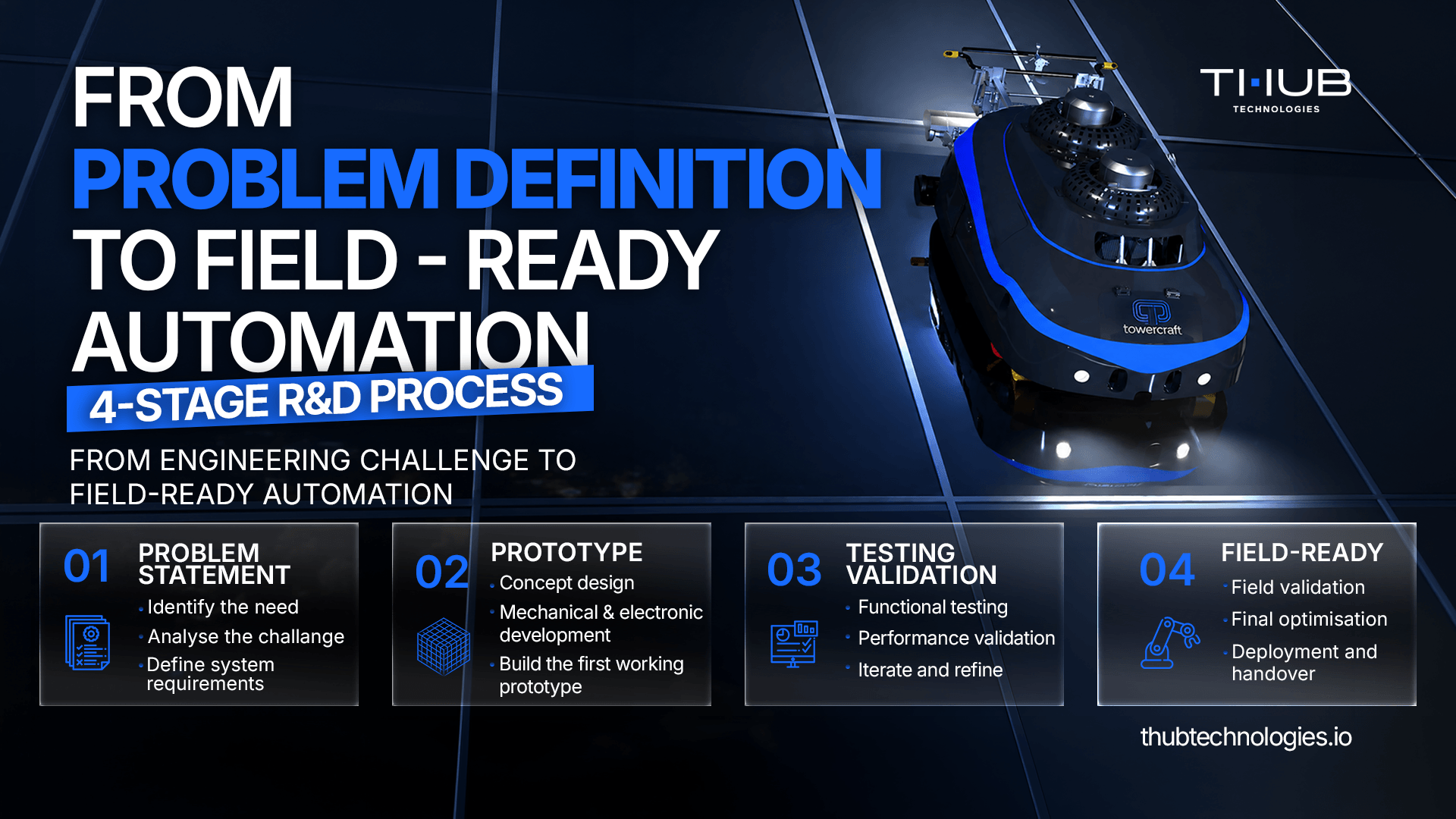
Research and Feasibility
The initial phase of any automation project involves assessing whether a proposed approach is technically viable under the constraints of the target environment. This includes evaluating sensor technologies, communication architectures, energy requirements, and safety considerations. Feasibility research prevents costly pivots later in the development cycle.
Prototyping and Iteration
Prototyping is where abstract engineering concepts meet physical and operational reality. Iterative testing allows engineering teams to identify weaknesses in design assumptions before a system enters wider deployment. Each iteration refines performance, resilience, and adaptability — qualities that determine whether an automation system remains functional over its operational lifespan.
Validation in Real-World Conditions
Laboratory results, however promising, do not guarantee field performance. Validation testing under actual deployment conditions is a critical checkpoint in responsible engineering. Systems must demonstrate consistent behaviour across variable conditions — environmental, operational, and infrastructural. This phase is particularly important in applications where system failures carry safety or regulatory implications.
Integration and Deployment Readiness
A field-ready automation system is not merely one that works in isolation. It must integrate with existing infrastructure, communicate with adjacent systems, and operate within established safety and data governance frameworks. Deployment readiness involves not only the technology itself but the documentation, maintenance protocols, and monitoring capabilities that support its long-term operation.
Automation in Context: Smart Infrastructure and Beyond
The scope of field-ready automation extends well beyond individual machinery or isolated processes. In smart city infrastructure, for example, automated systems must function as components within a broader, interconnected environment — managing data flows, responding to dynamic inputs, and contributing to system-wide efficiency objectives.
THUB Technologies approaches automation with this systems-level perspective. Engineering solutions are developed not as standalone products but as components of larger operational and infrastructural frameworks. This perspective shapes decisions made at every stage of the R&D cycle, from initial problem definition through to ongoing post-deployment monitoring.
Whether the application involves autonomous inspection systems, AI-assisted building management, or robotics deployed in complex environments, the principle remains consistent: automation that is engineered with context in mind performs more reliably and delivers more durable value.
The Role of Data in Closing the Feedback Loop
One of the distinguishing characteristics of mature automation is its capacity to generate actionable data. Field-deployed systems that monitor their own performance — capturing operational metrics, environmental readings, and anomaly signals — provide the feedback necessary for continuous improvement.
This data-driven approach enables engineering teams to refine systems after deployment, not only during development. It also supports evidence-based decision-making for facilities managers, infrastructure operators, and technology leaders who rely on accurate operational intelligence to manage assets effectively.
Conclusion
The path from problem statement to field-ready automation demands rigorous engineering discipline, contextual awareness, and a commitment to real-world performance rather than theoretical capability. THUB Technologies' R&D approach is grounded in this understanding — ensuring that the automation systems it develops are not only technically sound but operationally meaningful. As the complexity of built environments and urban infrastructure continues to grow, this structured approach to engineering-led automation will remain central to delivering solutions that organisations can depend on.